
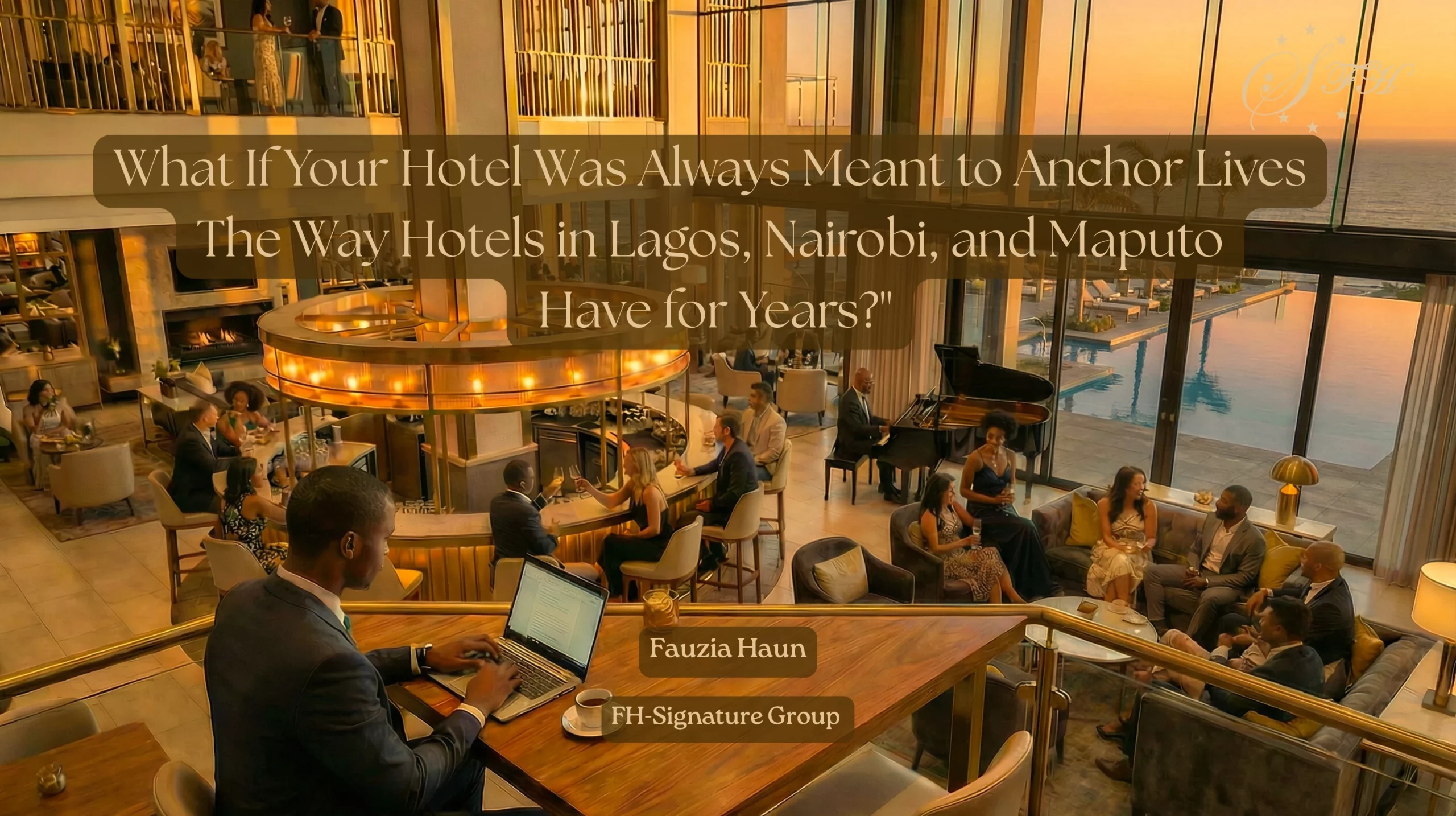
Hotels in Lagos, Nairobi, and Maputo Never Mistook Themselves for just Accommodation. Perhaps Yours Shouldn’t Either. Have You Thought about Anchoring Lives?
There is a moment that occurs in certain hotels when a guest settles into themselves – comfortable enough to let time move at its own pace, present enough to notice the room around them.
The guest has recognised themselves in the space as someone who belongs there, whether or not they ever book a room.
This shift represents an evolution in how hotels understand their relationship with the communities they serve. Like a tree that extends roots as deeply as it grows tall, hotels that flourish are those that anchor themselves in the daily rhythms of the people around them.
What I Witnessed in Maputo
I understood this on a Tuesday evening in Maputo.
My family had gathered – no one staying overnight – at one of the city’s hotels. Over time, this space had quietly become ours.
There was a piano playing – live music that filled the room without dominating it. My family sat in a corner we had claimed as familiar over multiple visits. Drinks arrived without needing to be ordered twice. Conversations unfolded naturally, the way they do when a space allows you to simply be.
As I looked around the room, I noticed other groups had made the same quiet claim. They were there because the hotel had become the place where a particular version of their life occurred – where time moved slower, where presence felt possible, where the city’s pace softened into something restorative.
The hotel was holding space for lives being lived.
When a hotel becomes part of someone’s inner narrative – part of the story they tell themselves about who they are and how they live – it creates a relationship far deeper than any amenity list can capture.
That relationship is built through return.
What African Markets Have Perfected
In cities like Lagos, Johannesburg, Nairobi, Accra, and Maputo, hotels have developed an understanding that properties elsewhere are beginning to explore.
They function as continuums, woven into the fabric of daily life.
Walk into a well-positioned hotel in one of these cities on any given evening, and you will find a space already occupied by people whose lives are unfolding there in real time.
The entrepreneur closing a deal over breakfast. The professional working silently in a corner that has, over months, become theirs. The family celebrating a milestone because this is where they mark what matters. The couple meeting for pre-dinner drinks because this is their ritual – and rituals, once formed, create their own gravity.
These people do not have room keys. They have something more valuable: a relationship with the space that does not require permission or explanation. The hotel has become the place where a particular version of themselves exists – one they cannot access as fully anywhere else.
This is what happens when a property moves from housing guests to anchoring lives.
Why This Understanding Has Been Slow to Travel
For over a century, hotels have naturally oriented themselves around guests passing through – people temporarily housed, episodically engaged. Public spaces were conceived as transitions. Lobbies to be crossed. Lounges to be admired rather than inhabited. Restaurants positioned as amenities for those already staying.
This made sense within its context. It still makes sense for many properties today.
What has changed is the recognition that a hotel can serve two economies simultaneously – the economy of stays and the economy of presence. When both are designed for intentionally, something remarkable emerges.
A guest who stays once contributes to your occupancy. A local who returns three times a week contributes to your property’s place in the cultural fabric of a city. Like concentric circles in water, their influence ripples outward in ways that traditional metrics cannot fully measure.
When a hotel is woven into someone’s weekly rhythm – when it becomes where they work on Tuesdays, where they meet colleagues on Thursday evenings, where family gathers when something needs to be marked – the relationship transcends transaction.
It becomes about meaning.
And meaning, by its nature, endures.
The Psychology Beneath the Pattern
Human beings form loyalty to places that witness them.
A traveller who stays four times a year experiences your property as backdrop – beautiful, comfortable, ultimately interchangeable with others of similar quality.
A local who works from your lounge twice a week for six months experiences your property as co-author of their life. The table by the window where ideas clarified. The corner where difficult conversations became easier. The barista who knew their order before they spoke it. The sense that this space saw them as a person becoming.
This is the neuroscience of memory and attachment. We remember, and return to, the places that made us feel more fully ourselves.
When a hotel creates the conditions for that feeling to occur consistently and reliably, it moves from being a service to being essential.
What Designing for This Actually Looks Like
Creating a hotel that serves both economies means reimagining spaces to invite occupation as their primary purpose.
Public areas designed for extended presence. Seating that welcomes sustained work. Lighting that shifts with the day—energising at 9am, softening by 7pm. Acoustic design that holds conversations without intrusion. Layouts that allow someone to claim a corner naturally.
Programming that creates emotional rhythm. Live music on a quiet Tuesday. Rotating collaborations with local artists whose work becomes, for a time, part of the space’s identity. Small rituals – wine tastings, poetry readings, industry gatherings – discovered organically by people who feel they belong there.
Membership that signals belonging. A member who receives discounts is a customer. A member who feels ownership over your space – who brings guests to show them “my place” – extends your brand organically. The difference lies in how the offering is designed.
Operations that recognise people. When staff know a regular’s name, their usual table, how they take their coffee, without needing to ask, the relationship deepens naturally. These small recognitions compound over time, creating bonds that transcend any single visit.
Restaurants and bars positioned as destinations. Hotels in Maputo, Lagos, Johannesburg, and Nairobi have demonstrated this beautifully. Their F&B offerings stand as reasons to visit in their own right. Staying overnight becomes an option rather than a prerequisite.
The Mathematics of Return
Consider the patterns:
A traveller books 2 nights, spends £600, departs. Total engagement: 48 hours.
A local becomes a regular. Works from your lounge twice a week. Dines at your restaurant monthly. Hosts a birthday celebration in your private dining room. Recommends your property to colleagues, who begin holding meetings there. Over two years, direct spend: £8,000+. Indirect influence on your brand within the community: impossible to quantify fully.
Beyond the numbers, something deeper has occurred: your property has become part of the foundation of their life. A place that witnessed them. A place that made them feel more themselves.
This is loyalty in its most enduring form.
What Becomes Possible
When a property is designed for continuity, when it creates the conditions for people to return, something emerges that traditional hospitality metrics cannot fully capture.
The hotel becomes a place people describe with ownership: “We always meet there.” “It’s where I go when I need to think.” “It’s ours.”
Your restaurant fills six nights a week, independent of room occupancy. Your lounge becomes the preferred workspace for the city’s creatives and professionals. Your event spaces host moments people remember years later – proposals, celebrations, reunions. Live music on a Tuesday draws people who were not planning to come.
Your property is recognised by the version of life it makes possible – the particular quality of time, presence, and connection it enables.
This is the advantage that cannot be replicated through amenities alone.
The Insight Is Ancient, The Application Is Now
Hotels, at their origin, were gathering points. Social anchors. Spaces where strangers became familiar, where commerce and celebration intermingled, where life unfolded in all its unscripted complexity.
Over time, operational efficiency and the demands of scale shifted the industry’s focus. Hotels became optimised for accommodation: rooms, rates, occupancy. These remain essential, of course.
What is emerging now, particularly visible in African urban centres and spreading globally, is a remembering. A recognition that hotels can be both. That the same property can house travellers beautifully while simultaneously serving as social infrastructure for the community around it.
The most valuable relationships are those built on return. People return when a space holds something they need, a version of themselves, a rhythm, a ritual. A place that, amid a city’s movement, offers them constancy.
Your property is capable of this evolution. The question is simply whether you are curious to explore what it might look like for your context, your market, your community.
FH-Signature Group works alongside luxury and upper-midscale properties worldwide to explore how hotels can serve as continuity brands—spaces that anchor lives while accommodating guests. Our approach integrates behavioural guest psychology, spatial design, and strategic programming to create properties people return to because they hold a version of life that feels truer there than anywhere else.
If this resonates with where you are taking your property, I welcome the opportunity to explore it further with you. Sometimes the most valuable conversations begin with a simple question: what if?
Fauzia Haun
FH-Signature Group
Experience Meaning. Gift Excellence.